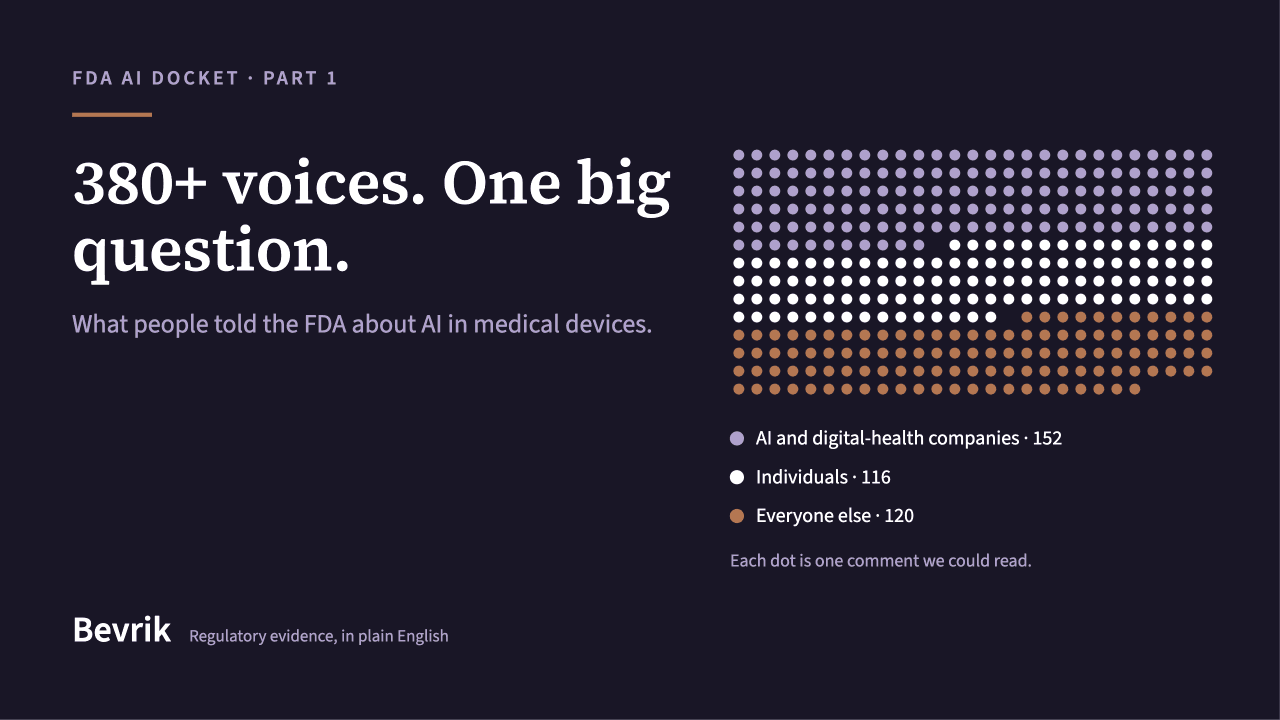
In August 2026, the FDA asked a big question. It shared a discussion paper with 26 questions. Then it asked the public to answer via FDA Docket FDA-2026-N-7874.
How should we check medical devices that use AI to write, talk, or create?
More than 380 people and groups responded. We read their comments. Here is what they said, in plain words.
What is this about?
Some AI tools write notes for doctors. Some chat with patients about symptoms. Some read a x-ray scan and write a report. These kinds of AI are called "generative AI". It makes new words or pictures each time you use it.
That is really hard for regulators right now. A normal device gives the same answer to the same input. Generative AI may not. It can answer in many ways. It can also be wrong while sounding sure. Also, the company that made the AI model may change it, even if the device maker did not ask for the change.
So the FDA shared some new ideas. There were three big ones:
- A way to size up risk for these devices → Ask two things. What does the tool do? And how bad is it if the answer is wrong?
- The AI could take a test like a doctor's exam → Test the AI first on many cases. Then check that it works with real patients.
- More checking after launch → Watch how the device does once people use it in the market.
Who answered?
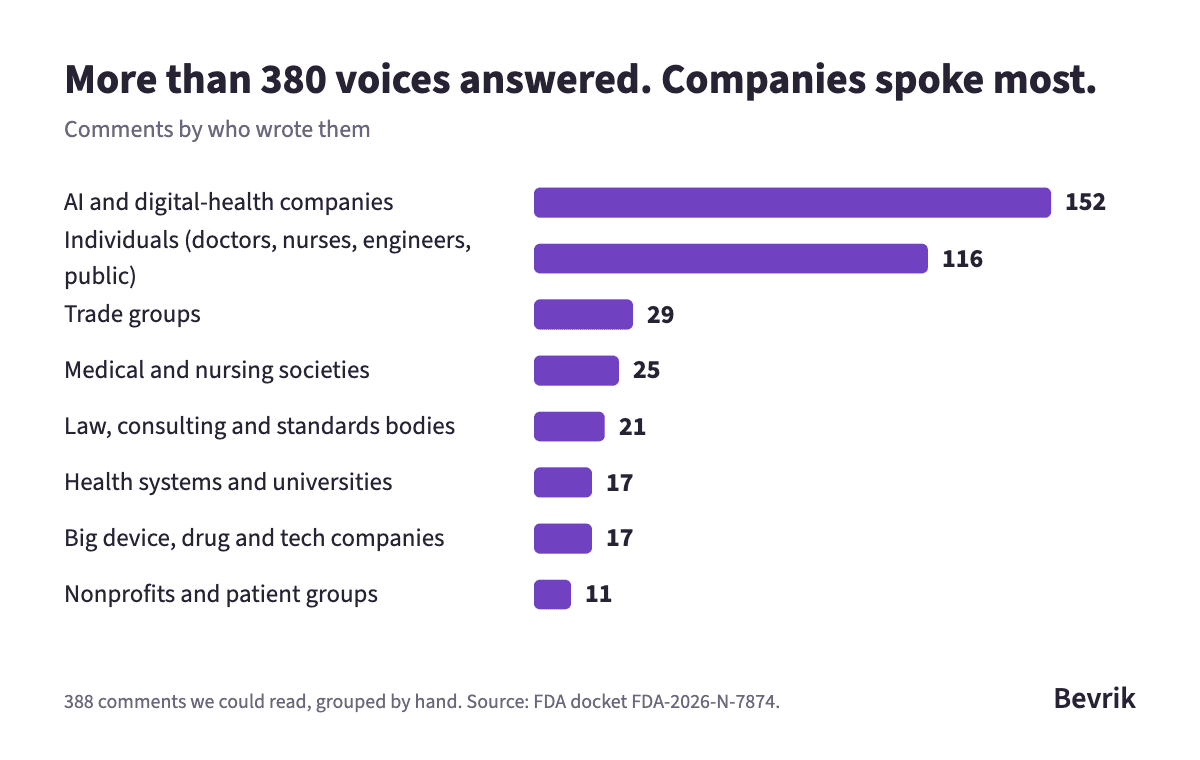
Companies spoke up the most. Of the 388 comments we could read, 152 came from AI and digital-health companies. Another 116 came from individuals, such as doctors, nurses, engineers, and members of the public. The rest came from trade groups, medical societies, hospitals, universities, law firms, and patient groups.
Some big names are in the mix. Some small ones. Here are a few: Palantir Technologies Microsoft Google Amazon Johnson & Johnson Anthropic MetaBrain Labs Inc. Thermo Fisher Scientific Oracle Health Bausch + Lomb iRhythm Technologies, Inc. Siemens Healthineers American Medical Association AdvaMed American Hospital Association AMIA (American Medical Informatics Association) WHOOP Kestra Medical Technologies, Inc. Hopper Healthcare Wolters Kluwer Health Grasshopper Health NOETIK UL Solutions - MET Laboratories Danaher Capacity Health AI Ketryx Tempus AI Hippocratic AI hims & hers Harrison.ai EVER FORTUNE.AI 長佳智能 Mosaic Clinical Technologies Wearlinq Ryden Solutions Flo Health Inc. Lunit Spring Health SolarisRTC ŌURA Newton's Tree.
Thank you to everyone who responded and provided input.
Where most people agreed
The FDA's "doctor's exam" idea got a warm welcome. In the first batch of comments, 39 of the 49 people who discussed it supported it, often with caveats. Four other ideas came up again and again.
1. Check after launch, too. But not instead of checking before.
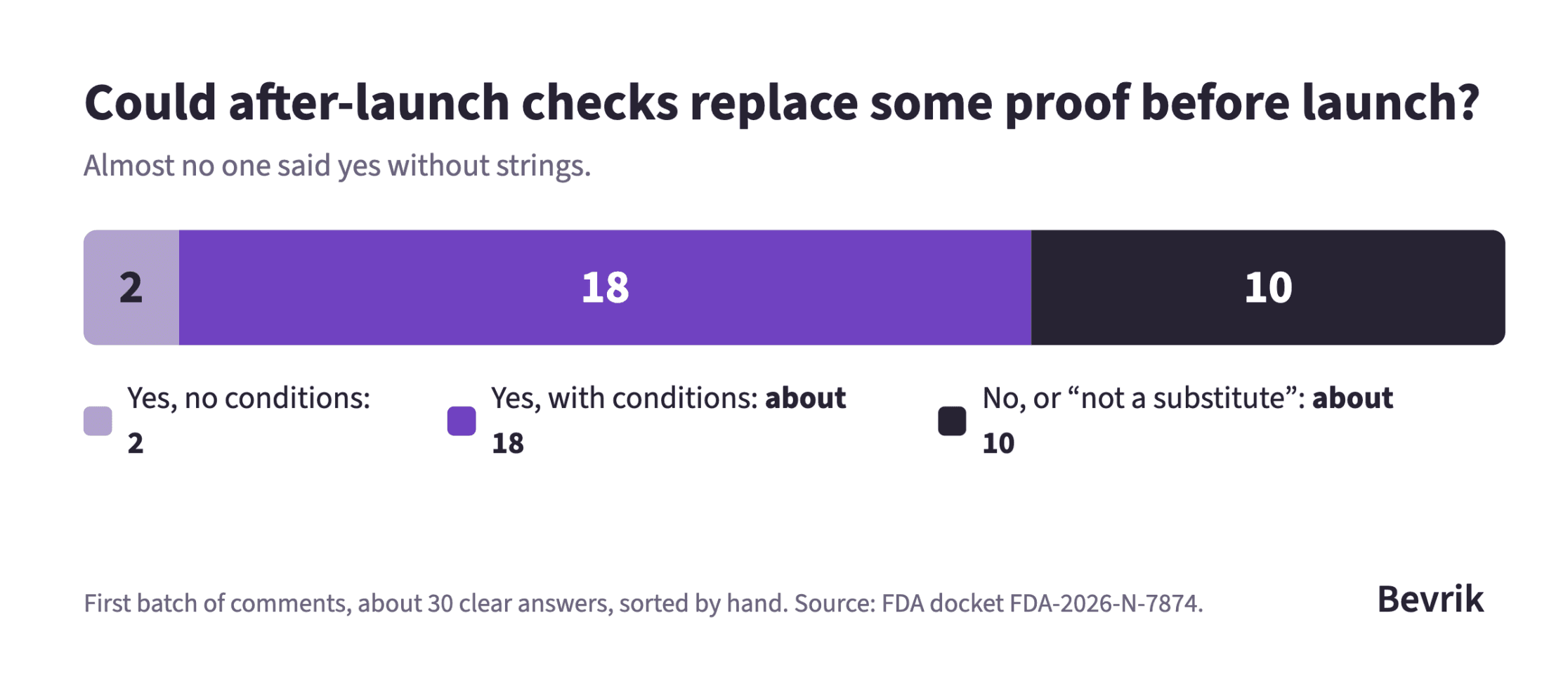
Could it accept less proof before launch if it watched the device closely after launch?
Almost everyone said "it depends", but only with strings attached. A typical post market follow-up scenario. In the first batch of comments, about 30 answers were clear. Only 2 said "yes" with no conditions. About 18 said "yes", with conditions. About 10 said "no", or said that watching later is no substitute.
The conditions were much the same each time. The harm must be small or easy to fix. Problems must be easy to spot. There must be a clear plan, and a way to roll the device back.
2. A patient using a tool does not make it risky by itself.
The FDA wondered if tools used by patients should count as higher risk. Many groups said to look at what the tool does and how bad a mistake could be. Who uses it should not decide alone. A few, like the Permanente Federation, said tools sold straight to consumers need more proof before launch.
3. Test the whole product, not just the AI inside.
An AI model may do well in a lab and poorly inside a real app. Many said the full device, as people use it, is what should be tested.
4. Keep a person accountable.
The American Medical Association said skill tests and accountability must go together. One pathologist asked a simple question. Will doctors be asked to sign off on results they cannot inspect?
Where people split
Outside testers. The FDA asked if independent groups should help test AI devices. Third party testing services. Testing and standards groups definately liked the idea. AdvaMed said the FDA should keep sole oversight. Others said any program should be optional. Overall mixed feedback was received.
A safety file for each AI model. The FDA floated the idea of a file that AI makers could share with it. Similar to a "Master File" concept. Many liked the idea. Some worried it would be unfair to companies without one. Others said a voluntary file is not enough. Again, the feedback was split.
Wellness and consumer tools. Some companies said tools that only give information should stay outside device rules. Some doctors and safety groups strongly disagreed. This topic appears contentious because it may also walk the line for mental health applications.
Tools that act on their own. Some AI tools do more than answer. They take steps, one after another. Many asked the FDA to go slowly here. The U.S. Chamber of Commerce asked for a public workshop before any guidance. Each step taken presents an opportunity for risk to occur and could become increasingly complex.
Different voices, different worries
The comments were not all alike. Each group worried about different things.
Companies and trade groups cared most about change and cost. By our count, about three in four of their letters talked about AI that acts on its own. About six in ten asked how to handle many small updates without a new FDA review each time. About the same share worried about cost and burden, especially for small firms.
Medical societies, hospitals, and universities cared most about people. About seven in ten talked about who is accountable. About seven in ten talked about how a tool fits into a busy day of care. About seven in ten raised bias. About one in three warned about people trusting the AI too much.
Patient groups, standards bodies, and law firms cared most about safety and rules. Mental health came up in about three in ten of their letters. It came up in very few company letters.
What was left out
The FDA's paper never mentions mental health, suicide, or crisis. A group of 12 patient, doctor, and consumer organizations pointed this out. They worry about chatbots that talk with people in distress. A law group that represents people it says were harmed by chatbots asked the FDA to treat health chatbots as devices.
A different way to ask
One comment came from an emergency doctor who runs a digital health company. His question was simple. What should Generative AI be compared against?
A new tool may not beat a trained specialist. But it may beat what people find with "Dr. Google". He asked the FDA to compare AI tools with what patients would really do at home.
What this means for regulatory teams
Nothing here is a rule yet. These are our reading of the comments, not FDA guidance. But three habits came up again and again:
- Track the AI version. Record which model and version made each result. Models change. Training data changes. Maintaining traceability and records is essential for development use but also for when released to market.
- Show who reviewed it. Keep a clear record of who checked each result and what they decided. Having a health care practitioner check the results is a risk control, but it also shifts the risk of decision making upon the practioner (and maybe after having received poor AI results)
- Plan checks after launch. Decide what you will monitor in post market, and what would make you act. Establishing performance benchmarks and actions alerts in your SOPs will support safe products in the market.
Teams that do these things now will have less to rebuild later.
At Bevrik, we are building software to help medical-device teams organize evidence and trace each finding back to its source. People stay in charge of every decision. Less paperwork. More confidence.
References
- FDA Discussion Paper: Considerations for the Regulation of Generative AI-Enabled Medical Devices https://www.fda.gov/media/185836/download
- FDA Announcement Requesting Public Feedback on Generative AI Medical Devices https://www.fda.gov/medical-devices/digital-health-center-excellence/fda-seeks-public-feedback-considerations-regulation-generative-ai-enabled-medical-devices
- FDA Docket FDA-2026-N-7874 (Public Comments) https://www.regulations.gov/docket/FDA-2026-N-7874
- FDA Artificial Intelligence-Enabled Medical Devices Resource Page https://www.fda.gov/medical-devices/software-medical-device-samd/artificial-intelligence-enabled-medical-devices
#FDA #AIML #RegulatoryAffairs #MedicalDevice
Originally published on LinkedIn.