Clinical Literature Search Report
A record of the search questions, terms, databases, dates and criteria, with selected publications, objective summaries, appraisal decisions, exclusions and reasons, search-flow counts and limitations.

Clinical evaluation
Bevrik’s approach connects the search strategy, study findings and working clinical documents. Your team can follow each conclusion back to its source and focus on the evidence gaps, safety and performance questions that need expert judgment.
Less paperwork. More confidence.
Where the hours go
Screening papers is only part of the work. Your team still has to appraise the full texts, extract results, check citations and carry the findings into the CEP and CER.
When the sources, notes and report drafts are separate, every update brings another round of copying and checking. Keep the findings and review context connected so your specialists can spend more time weighing the evidence.
The workflow
Provide your device description, intended purpose, patient population, variants and manufacturer-controlled claims. These inputs define the questions the literature needs to answer.
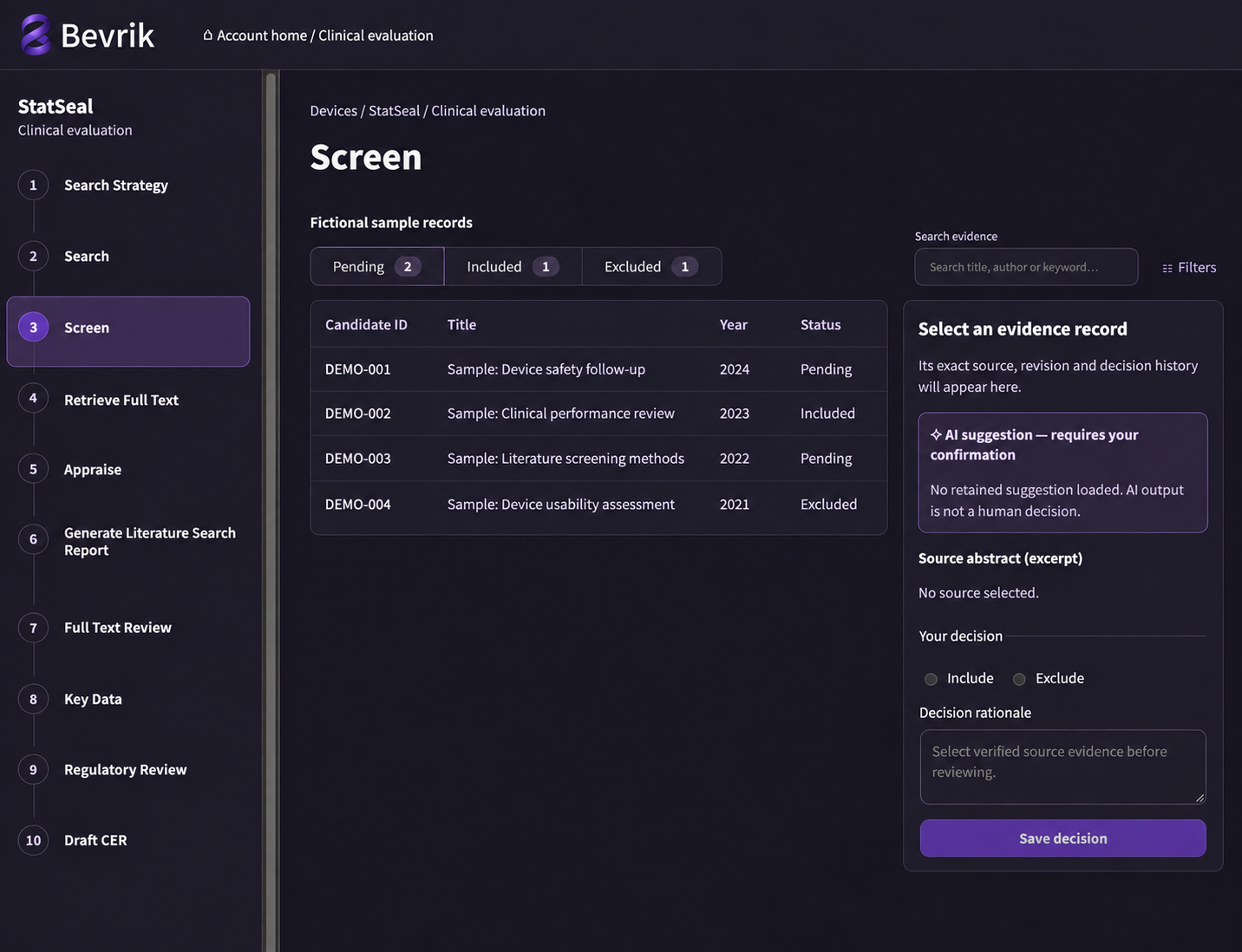
Review the proposed search strategy, then search and screen publications. Retrieve or upload full texts for appraisal, recording inclusion and exclusion decisions before finalizing the Literature Search Report.
Review the full texts in detail and extract study characteristics, safety and performance results with supporting source passages. Compare subject-device evidence with the state of the art, keeping limitations and evidence gaps visible.
Use reviewed evidence and manufacturer inputs to prepare the clinical evaluation plan and section-by-section report. Your team checks the content before export and completes formal approval through its own document-control process.
Clinical evaluation documents
These documents bring together your device information, search methods and reviewed evidence.
A record of the search questions, terms, databases, dates and criteria, with selected publications, objective summaries, appraisal decisions, exclusions and reasons, search-flow counts and limitations.
A working plan defining the clinical questions, methods, objectives and acceptance criteria, state-of-the-art approach, evidence needs and links to planned follow-up where applicable.
A reviewable report draft bringing together device information, clinical evidence, state-of-the-art comparisons, safety and performance results, benefit-risk discussion, references and disclosed evidence gaps.
Review the study results, source passages and decisions behind each document. Missing or conflicting evidence needs attention, not an invented answer.
Working documents need qualified review. Your team handles formal approval and signatures through its own document-control process. Ask us about the document formats and export options that fit your workflow.
Reviewable evidence
Retain publication references and supporting passages with study findings. Reviewers can inspect what was reported rather than rely on a summary alone.
Separate subject-device evidence from state-of-the-art evidence. Keep study limitations and missing or conflicting results visible during the clinical analysis.
Use reviewed findings in working document sections, with their source context available for checking. AI interpretations remain proposals, not final clinical judgments.
Your qualified team checks the evidence and conclusions. Formal approval and signatures stay in your own document-control process.
The work that needs your expertise
Assess whether the evidence supports your device, intended purpose and manufacturer-controlled claims.
Decide what incomplete or conflicting findings mean and what additional evidence or follow-up your device needs.
Explain the clinical reasoning, benefit-risk discussion and limitations in a working report that your reviewers can assess.
From research to your next step
Read a practical guide, find a starting document and explore how Bevrik supports the work.
Find guidance, organize your evidence needs and explore a connected clinical workflow.
Understand
Explore clinical evaluation articles →Start
Clinical Evaluation Plan template →Manage
Explore Clinical Evaluation →Start with one recurring task
Pick the task that takes too much preparation. Walk through the Bevrik approach, confirm the available workflow and identify the review your team would still need to do.