
Risk Management

Spend more time evaluating risks. Less time maintaining the risk file.

Keep hazards, harms, controls and supporting evidence together. Review initial and residual risks, see what changed and prepare clear reports without piecing the same information together across separate files.

Where the time goes

The spreadsheet is only part of the work.

A risk assessment may rely on a test report, a procedure, instructions for use or a clinical finding. When those records are scattered across files, reviewing the assessment means finding the right versions and reconstructing the reasoning.

Bevrik brings the assessment and its supporting references into view, so your specialists can focus on the hazards, evidence gaps and control decisions that need their judgment.

01 / A reviewable risk assessment

See the assessment at a glance

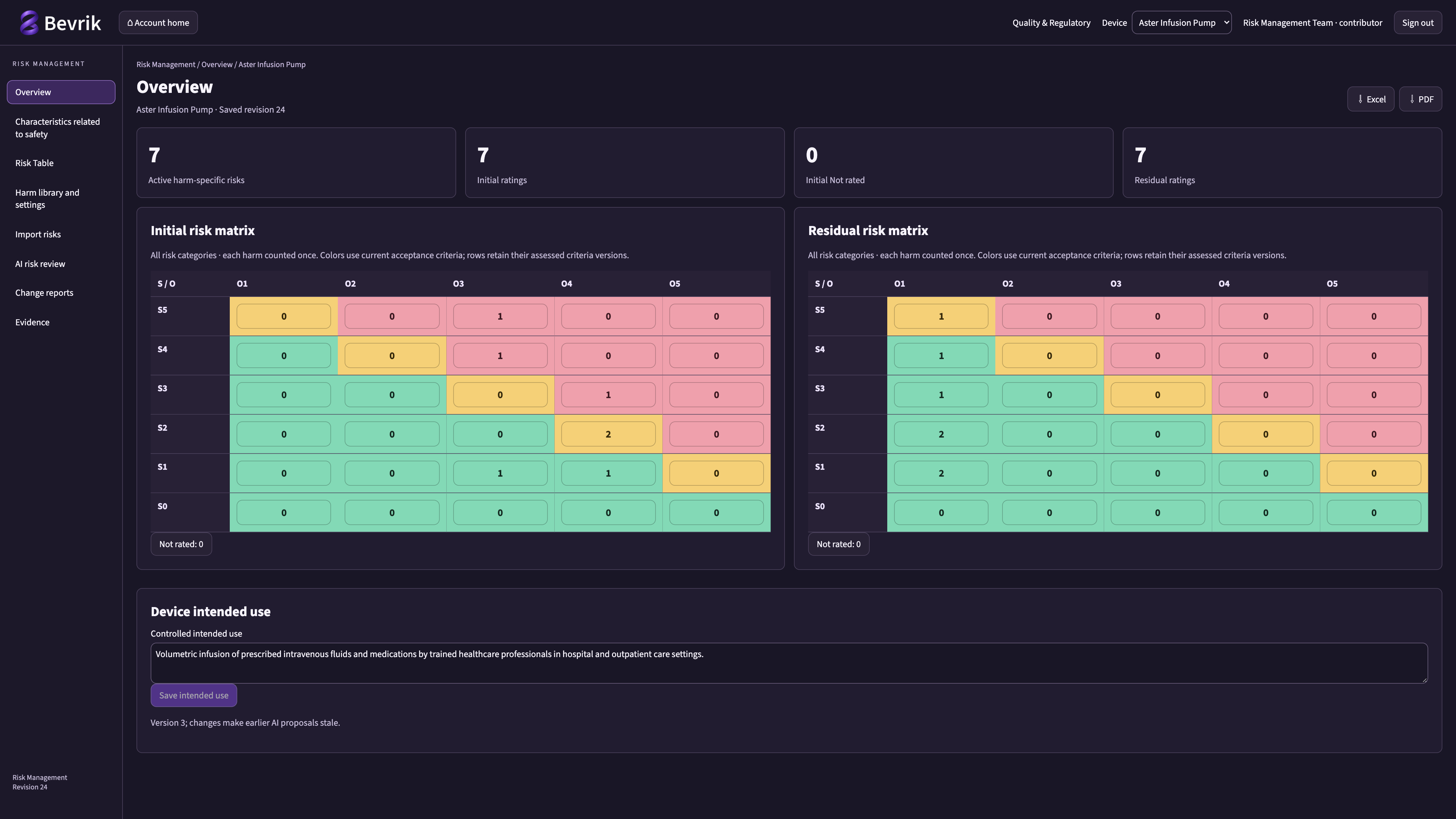
Compare initial and residual risk assessments and see where information is missing. An assessment without a rating stays unrated; it is never shown as zero or low risk.

Risk overview and assessment matrices

Initial and residual risk matrices, with rated and unrated assessments counted separately.

Actual Bevrik interface with fictional demonstration data. Document references and review states are illustrative, not verified evidence or regulatory approval.

View full size

02 / A reviewable risk assessment

Follow the pathway to each harm

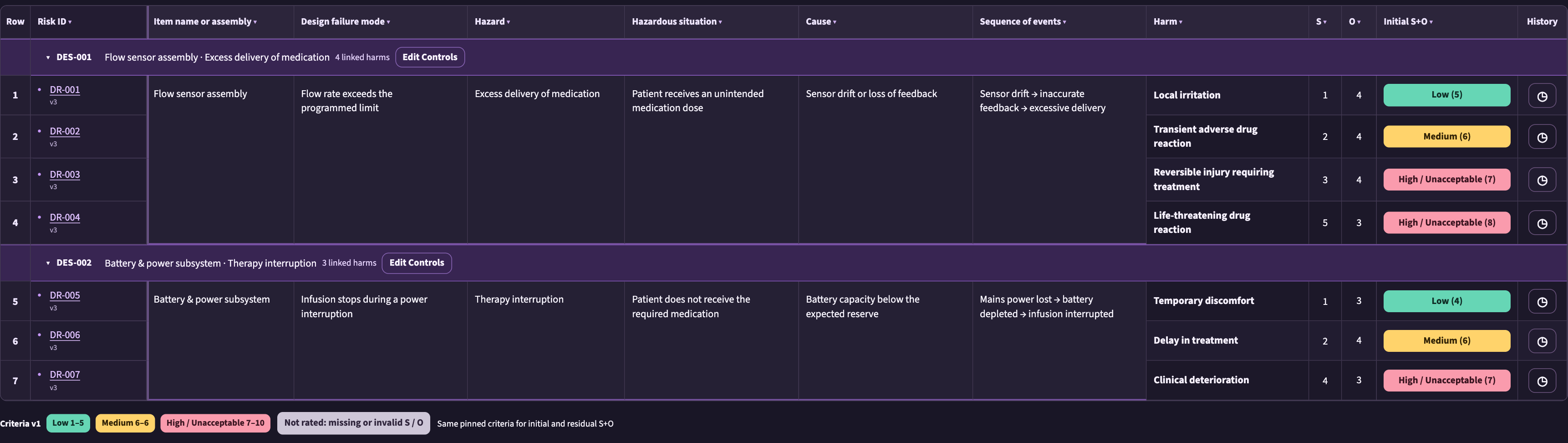
One hazardous situation can lead to several harms. Keep the shared pathway together while assessing each harm separately, with its own severity, occurrence and linked controls. Apply the same approach to design, process and use-related risks.

One risk pathway, several possible harms

One shared risk pathway, expanded to show each harm and its initial severity, occurrence and risk assessment.

Actual Bevrik interface with fictional demonstration data. Document references and review states are illustrative, not verified evidence or regulatory approval.

View full size

03 / A reviewable risk assessment

Find the evidence behind the control

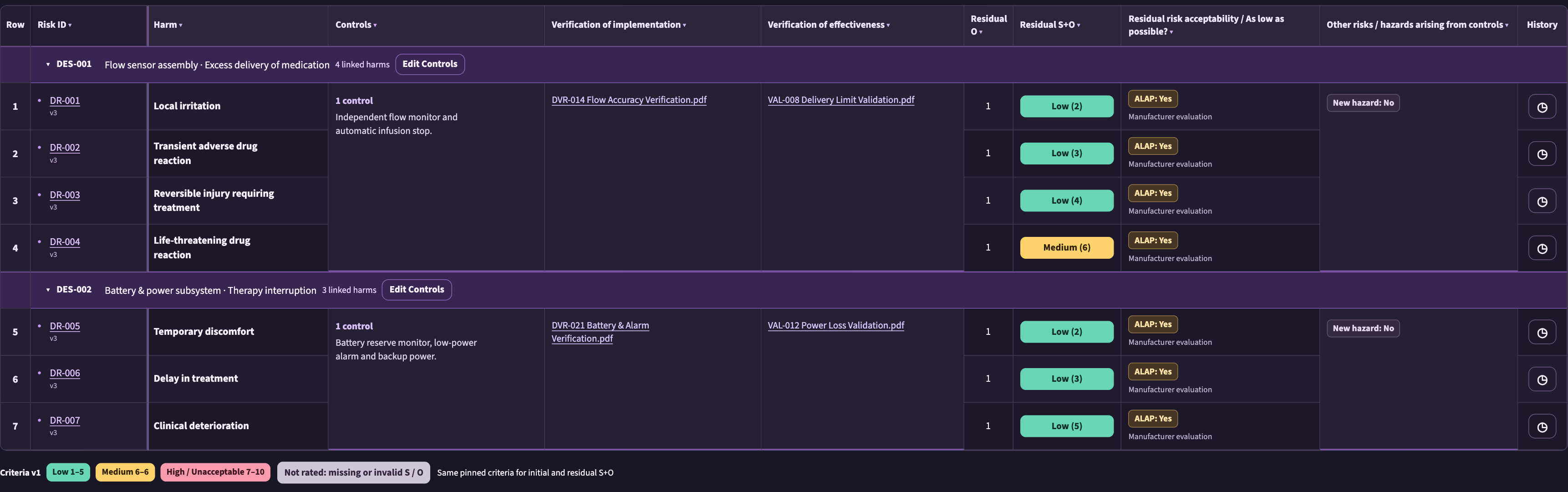
See which documents support a control’s implementation and which support its effectiveness. Keep those references separate: a document name is not a verified source, and linking a document does not prove that a control works.

Shared controls with separate implementation and effectiveness references

Shared controls, implementation references, effectiveness references and residual risk assessments.

Actual Bevrik interface with fictional demonstration data. Document references and review states are illustrative, not verified evidence or regulatory approval.

View full size

04 / A reviewable risk assessment

See what changed. Take the assessment with you.

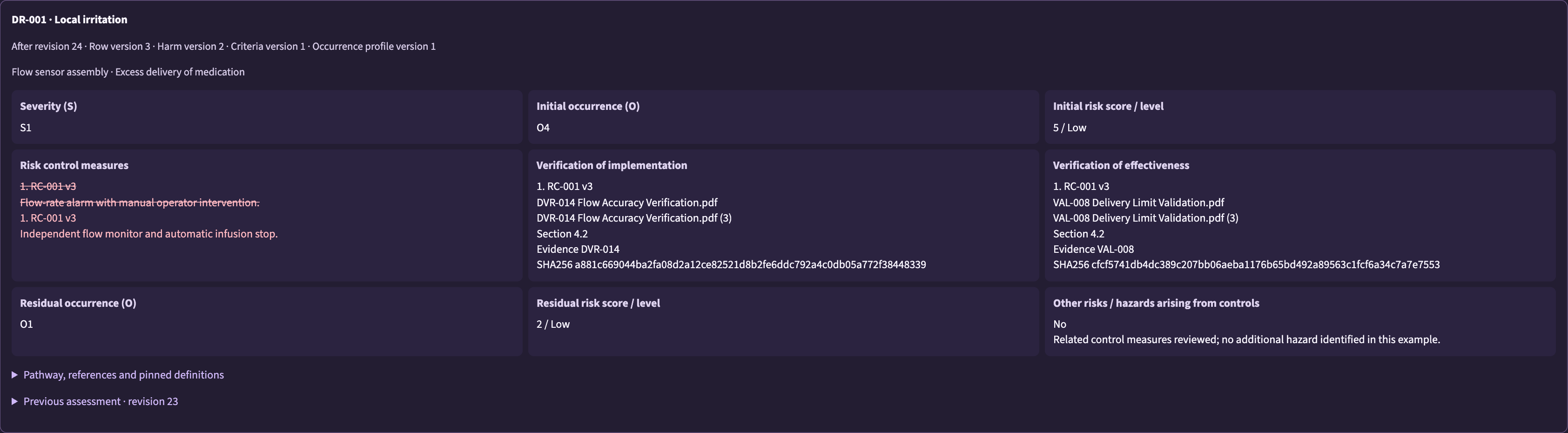
See who changed an assessment and compare the information before and after each change. Export readable Excel and PDF files for your team’s review and existing quality process.

Risk change report with marked-up control text and assessment history

A change report showing previous and revised control text, assessment versions and supporting references.

Actual Bevrik interface with fictional demonstration data. Document references and review states are illustrative, not verified evidence or regulatory approval.

View full size

Consistent terminology. Clear assessment history.

Keep the meaning behind each risk rating.

Connect harms to IMDRF terminology

Link a device’s Harm Library entries to relevant IMDRF codes and terms without replacing your team’s harm descriptions or severity assessments. A person confirms each mapping; AI suggestions remain separate. Each risk assessment retains its selected harm version, so a library change does not silently rewrite its history.

Define what occurrence means for your device

Use device-specific occurrence bands to give your team a consistent basis for assigning occurrence categories. Retain the profile version used in each assessment. An occurrence estimate is not a measured event rate, and changing the bands does not silently change earlier assessments.

IMDRF terminology helps classify harms; it does not determine severity, occurrence or risk acceptance. Code coverage and source-release scope should be reviewed for your device.

Keep the gaps visible

An incomplete assessment should not look complete.

Save work without hiding the gaps

Save incomplete rows while keeping missing ratings, references and control information visible. Saving an assessment does not mean the risk has been accepted.

Keep engineering judgment distinct

Distinguish source-reported facts from your team’s interpretation. AI suggestions are not risk acceptance or proof of control effectiveness.

Keep formal approval in your process

Your qualified team evaluates the assessment. Final document approval and signatures stay in your own quality and document-control process.

The wider evidence picture

Risk decisions should inform the rest of your regulatory work.

Clinical findings, instructions for use, labelling, manufacturing records and post-market surveillance findings can all inform a risk review. Your team needs to find the source, understand what it means and decide which assessments or documents need attention.

  1. 1

    Source information

    Device information, test evidence, clinical findings and surveillance records.

  2. 2

    Risk assessment

    Hazards, harms, controls, initial and residual assessments, and supporting references.

  3. 3

    Qualified review

    Consider implications for clinical, compliance and surveillance work.

Conceptual relationship, not a claim of automatic data transfer or completed cross-module integration. Connected module availability and scope are confirmed during discovery. No automatic changes to risk records or regulatory conclusions are implied.

The planned PMS connection

Compare surveillance findings with your risk assumptions.

The planned connection between post-market surveillance (PMS) and Risk Management compares a supported observed event rate with the occurrence band used in the risk assessment. Your team reviews any proposed change; the risk file is not updated automatically.

  1. 1

    Use comparable data

    Match confirmed event counts with a compatible exposure total, device scope and observation period. Without that information, the rate comparison is not assessable—not zero.

  2. 2

    Compare the occurrence band

    Compare the observed rate with the band in the assessment’s retained device profile. Record rate changes and identify any crossing into a higher category.

  3. 3

    Review a proposed change

    Show the source evidence, calculation, existing category and proposed category. Your team decides whether reassessment is needed; no automatic change is made.

Planned workflow, not a claim of a completed PMS integration. Report counts alone are not an occurrence rate, and an observed rate is not automatically a measure of true incidence.

Start with your next assessment

Bring one risk pathway. Follow the evidence.

Use a discovery call to walk through a hazard, its possible harms, the controls and the evidence your team needs to review. See where Bevrik fits your current process.

Explore the Risk Assessment Template and other resources →

From research to your next step

Continue with your task.

Read a practical guide, find a starting document and explore how Bevrik supports the work.

Start with one recurring task

Where does your risk review take the most preparation?

Pick the task that takes too much preparation. Walk through the Bevrik approach, confirm the available workflow and identify the review your team would still need to do.