For medical-device regulatory & clinical teams

Give your regulatory team time back.

Literature searches. CER updates. Compliance matrices. Risk files. PMS reports. The same evidence keeps your specialists busy in five different places.

Bevrik’s approach connects the sources, review and working documents—so your team can focus on the decisions that need its expertise.

Bring one recurring task. No confidential files needed.

Less paperwork. More confidence.

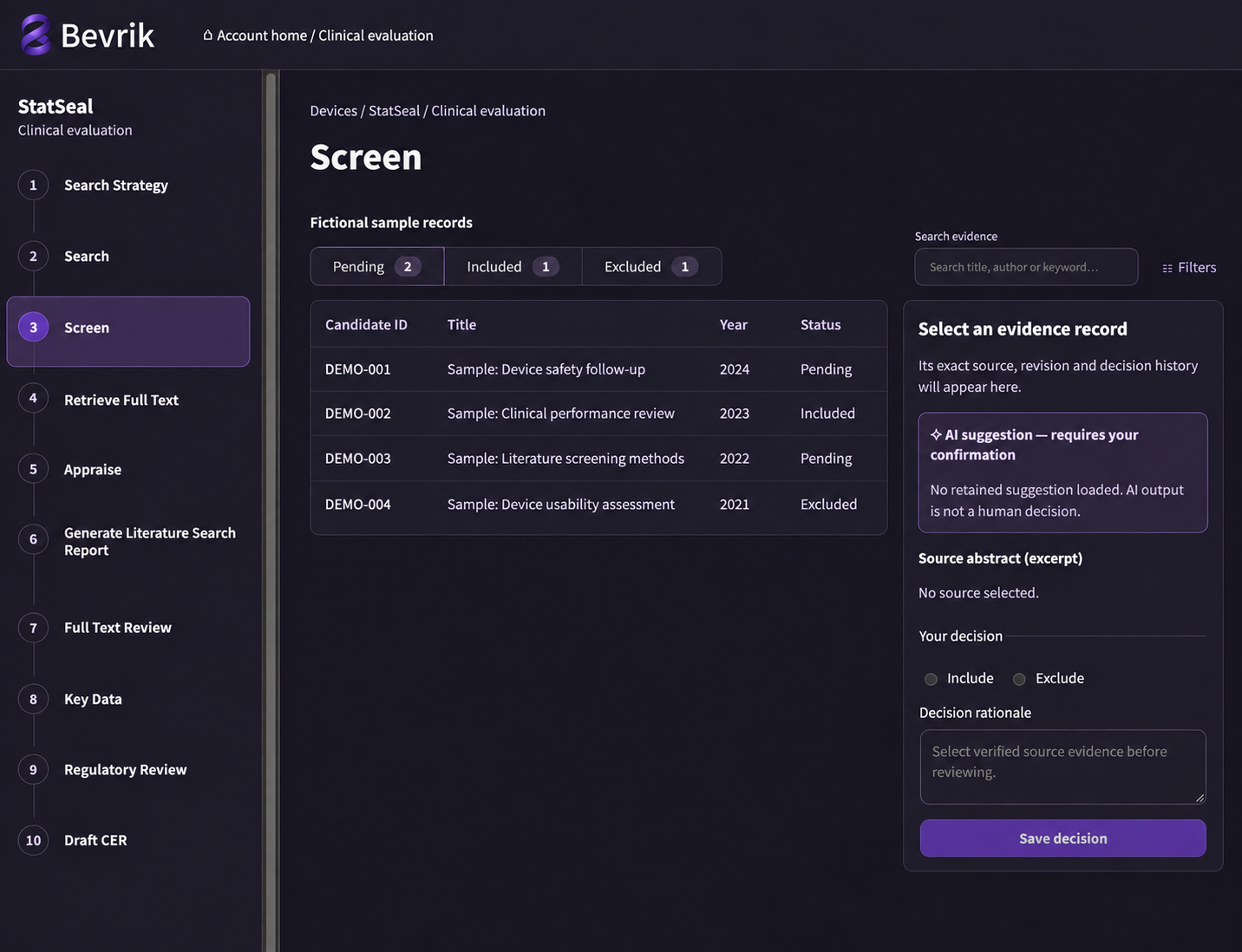
Clinical evaluation screening workspace with four fictional sample articles, candidate IDs, years and review statuses.
Illustrative workspace with fictional sample articles.
Open larger preview ↗
Sources you can inspectHuman review stays centralManufacturer-owned information

The real cost of disconnected work

Your experts’ hours are too valuable to spend rebuilding the same context.

Regulatory work does not end when a search or report is finished. New evidence, device changes and updated standards mean your team has to revisit earlier work.

When that information is spread across separate files, your specialists spend hours finding the latest version, copying results and checking references. That leaves less time for investigations, submissions and product development.

How Bevrik approaches the work

Keep the evidence connected. Stop rebuilding its meaning.

One source can support several pieces of regulatory work. Keep its finding, context and review visible wherever it is used.

01

Literature searches

Explore literature searches

Where the time goes

Search again. Screen again. Rebuild the methods, citations and reasons for every update.

The Bevrik approach

A structured path from search strategy through screening and appraisal, with source findings and review decisions kept together.

More attention on the studies that matter, less effort reconstructing how you found them.

02

Clinical Evaluation Reports

Explore clinical evaluation

Where the time goes

Move findings between papers, spreadsheets and report drafts, then check that the references still match.

The Bevrik approach

Use reviewed findings in clinical analysis and working CER sections, keeping subject-device evidence and state-of-the-art evidence distinct.

More time weighing the evidence and resolving gaps, less repeated assembly.

03

Standards compliance matrices

Explore GSPR & Standards

Where the time goes

Track clauses, editions, methods and supporting documents across separate files.

The Bevrik approach

Connect requirements, selected standards and evidence references in a reviewable matrix; retain the context when evidence or editions change.

More time assessing what a change means for your device, less time finding the affected records.

Where the time goes

Reconcile hazards, harms, controls and supporting evidence whenever a file changes.

The Bevrik approach

Keep harm-specific risk records, controls and source references together, with clear revision history and human decisions.

More time on risk decisions and controls, less effort reconciling versions.

Where the time goes

Gather new literature and event reports, then work out what they mean for clinical evidence and the risk file.

The Bevrik approach

Build surveillance around the prior search protocol, source records and reviewable risk-change proposals; bring PMCF findings back into the evidence workflow.

More time investigating signals, less repeated collection and report preparation.

Your agreement defines the available modules and scope. Your team reviews the evidence and makes the regulatory decisions.

Risk Management

A risk file your team can follow, not just fill in.

Keep hazards, harms, controls and supporting evidence together. Spend less time reconciling separate files and more time evaluating what the risks mean.

  • Keep related risks together. Follow a shared pathway while assessing each harm separately.
  • Keep evidence within reach. See the references behind control implementation and effectiveness.
  • Keep changes explainable. Review assessment history and prepare readable Excel and PDF outputs.
Explore Risk Management
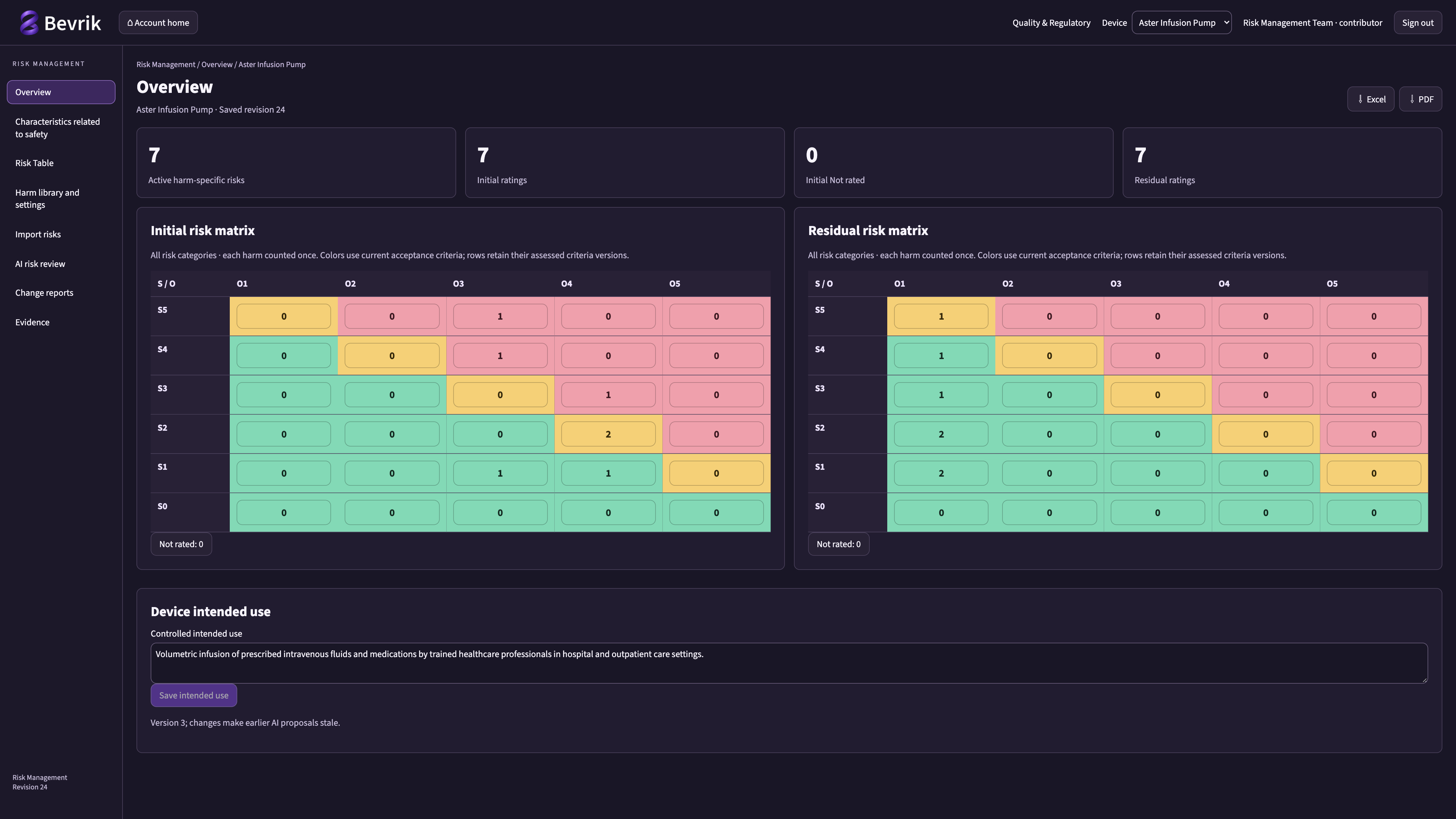
Risk assessment overview with initial and residual matrices

Compare initial and residual assessments, with rated and unrated items identified separately.

Actual Bevrik interface with fictional demonstration data. Document references and review states are illustrative, not verified evidence or regulatory approval.

View full size

GSPR & Standards Compliance

From a requirement to the evidence behind it.

Stop rebuilding the reasoning behind every checklist row. Keep applicability, methods, standard editions and supporting document revisions together for your team’s review.

  • Explain what applies. Record applicability or non-applicability with a clear, requirement-specific justification.
  • Show the supporting version. Connect each requirement to the exact evidence revision and explain what it supports.
  • Keep edition changes reviewable. Retain your team’s impact assessments, actions and earlier records.
Explore GSPR & Standards Compliance
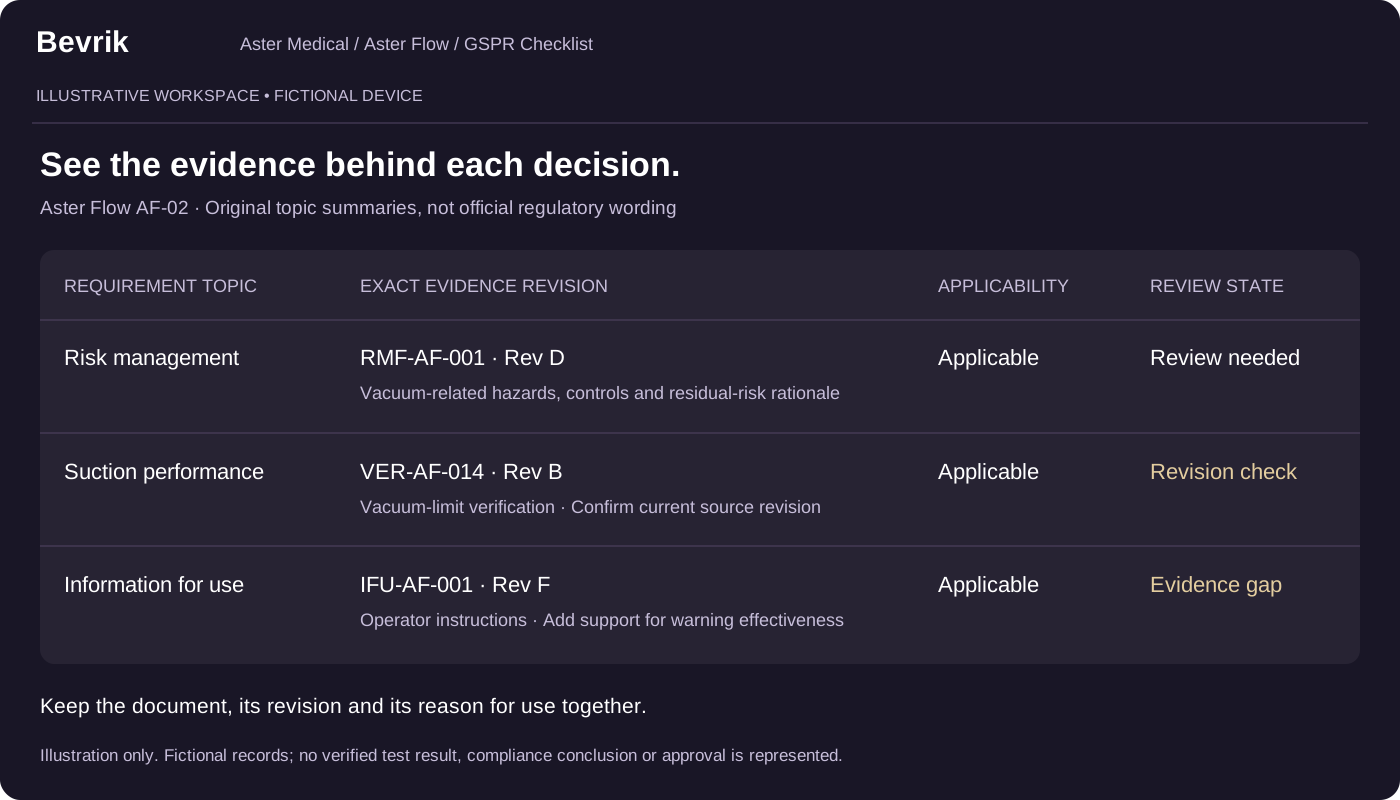
Evidence-centered GSPR matrix

Aster Flow example: risk, verification and instructions-for-use documents beside the requirement topics they support, with review needs kept visible.

Illustrative workspace—not an actual product screenshot. Aster Flow is a fictional device; documents, links and review states are examples, not verified evidence. Topic summaries are not official regulatory or ISO clause text and do not establish compliance or approval.

View full size

The change you want

Less repetitive preparation. More room for expert work.

Put expertise where it matters

Spend attention on interpreting evidence, understanding your device and resolving the questions that affect safety and performance.

Keep updates reviewable

Work from visible sources and retained decisions instead of rebuilding the context whenever a report or requirement changes.

Protect time for priorities

Make room for investigations, submissions, product support and thoughtful review by targeting repeated preparation first.

Put a value on the work

How much staff time is tied up in preparation?

Enter your team’s hours over a 12-month period, across all scopes. Count each hour once: literature work already counted in the first field should not also be counted under CERs.

Annual staff workload value

$0.00

0 hours per year

That is capacity committed to the work you entered. It shows where to investigate repeated preparation—not what Bevrik will automatically save.

Example arithmetic: 500 hours at $120/hour represents $60,000 of staff time. This is an illustration, not an industry average or a Bevrik savings result.

Explore the detailed regulatory workload calculator →

See the mechanism

From a source to a decision you can explain.

  1. 1

    Keep the source

    Start with literature or manufacturer evidence and preserve its identity and context.

  2. 2

    Review the finding

    Check the reported result, its source passage, limitations and relevance to your device.

  3. 3

    Reuse the context

    Carry reviewed findings into the clinical work and supporting relationships they inform.

  4. 4

    Review the output

    Your team checks the working document and handles formal approval in its own process.

Explore the clinical evaluation workflow →

Useful working outputs

Evidence that carries through to the documents.

Clinical Literature Search Report

A record of the search questions, terms, databases, dates and criteria, with selected publications, objective summaries, appraisal decisions, exclusions and reasons, search-flow counts and limitations.

Clinical Evaluation Plan (CEP)

A working plan defining the clinical questions, methods, objectives and acceptance criteria, state-of-the-art approach, evidence needs and links to planned follow-up where applicable.

Clinical Evaluation Report (CER)

A reviewable report draft bringing together device information, clinical evidence, state-of-the-art comparisons, safety and performance results, benefit-risk discussion, references and disclosed evidence gaps.

Risk Assessment Table

Hazards, harms and risk assessments, with traceable evidence showing how risk controls are implemented and whether they are effective.

Compliance Matrices

Applicable and non-applicable standards requirements, the justification for each decision and traceable evidence supporting implementation.

GSPR Checklist

General Safety and Performance Requirements (GSPR), with applicability and non-applicability decisions, justifications and traceable evidence supporting implementation.

Your team handles formal approval and signatures through its own document-control process. Source-supported drafts, risk assessments and applicability decisions still need qualified review.

One offer for medical-device manufacturers

From your first device to a growing portfolio.

A small team building its first device

Build an evidence process that supports regulatory review without letting repeated preparation crowd out testing and product development.

A team maintaining a device portfolio

Keep recurring searches, reports, standards and risk updates connected as the portfolio grows.

Startups are manufacturers too. The same workflows and pricing apply; your starting point and agreed scope shape the setup.

Explore the Bevrik solution →

One plan for every manufacturer

The same pricing, wherever you are starting.

$15,000/year

Standard subscription. Billed annually, starting in Year 1.

$10,000/year

With a signed three-year agreement. Still billed annually.

$2,500 once

Standard setup, kickoff, training and onboarding materials.

One subscription: Clinical Evaluation, Risk Management, GSPR & Standards Compliance, and PMS Tracking.

Both options include all generally available standard modules within your agreed scope, plus three clinical evaluation scopes. Module availability and limits are confirmed before contracting. Each extra clinical evaluation scope costs $2,500 per year.

See what is included →

A practical start

You do not have to figure out the setup alone.

The $2,500 standard implementation includes your workspace, the first three scopes, a 60-minute kickoff, a 90-minute training session and onboarding materials.

Agree the task, inputs and reviewers first. Keep migration, custom integrations and consulting separate from standard setup.

  1. 1. Bring a real bottleneck.

    Pick one search, report or recurring update that takes too much preparation.

  2. 2. Walk through the approach.

    See what stays connected and what your team still needs to review.

  3. 3. Decide on the fit.

    Agree a useful next step, clear scope and commercial terms.

Before you decide

Clear answers beat a bigger promise.

Does this replace our regulatory team?

No. The goal is to reduce repeated preparation so your specialists can spend more time on evidence interpretation, device decisions and review. Your team keeps regulatory responsibility and final document approval.

Can we see how it would work for our task?

Yes. Bring one recurring task and your main questions to a discovery call. We will discuss the workflow, show the relevant approach and identify the inputs and review your team would still need to provide.

Are all these workflows included in the subscription?

The subscription includes all generally available standard Bevrik modules under your agreed scope. There is no separate subscription charge for each standard module. We confirm the available workflows, usage and support limits before you sign.

How do we know whether it is worth the cost?

Start with your current preparation hours, reviewer effort and external costs. Evaluate a specific workflow and include setup, review and corrections in the comparison. Freeing staff capacity is valuable, but it is not automatically a cash saving.

Will AI invent evidence?

AI can make mistakes. Bevrik’s intended workflow uses published journal content provided for review, rather than asking AI to create evidence. Reference publications are retained, and conclusions are linked to their sources so reviewers can check that each conclusion is supported by the referenced content. Source checks and human review remain essential: traceability makes conclusions easier to verify, but does not guarantee that every AI interpretation is correct.

Does Bevrik replace a regulatory consultant?

No. Bevrik is designed to help your team organize evidence, review literature and prepare working documents—not replace professional expertise. Understanding your device, its intended purpose, risks and regulatory pathway still requires device-specific knowledge and judgment. Your qualified team or regulatory consultant reviews the evidence and conclusions; the manufacturer retains regulatory responsibility and final document approval.

Start with the work in front of you

Which recurring task would you most like to take off your team’s plate?

Bring that question to a discovery call. We will look at the workflow, the review effort and whether Bevrik is a useful fit.

Book a Discovery Call

A focused conversation. No confidential files required.